Thursday, January 10, 2008

What is Art - Part Six

I think we've got enough background, now, to show and discuss all sorts of unusual art (or is it?).

So let's start with these insect sculptures, involving real insect specimens and clockwork parts.

Here is what Mike Libby has to say about these:

"One day I found a dead intact beetle. I then located an old wristwatch, thinking of how the beetle also operated and looked like a little mechanical device and so decided to combine the two. After some time dissecting the beetle and outfitting it with watch parts and gears, I had a convincing little cybernetic sculpture. I soon made many more with other found insects and have been exploring and developing the theme ever since."

See many more of them, here.

So is it art? It certainly gets reactions. See comments on this post from qarrtsiluni. What do you think?

Wednesday, January 9, 2008

Autumn

I had been grinning like an idiot on one of my autumn walks with Moomin Light because the Bradford pear trees in our neighborhood had just a few hot colored leaves, in yellows, oranges and reds, in the bottom half, and their bare black cages of branches, recently wet, stood against an autumn blue sky. I loved them.

Later in the walk, a family of crows flew over, skylarking about in the wind, and I realized how much crows mean autumn to me.

So this painting was conceived, and fell together quite quickly. The tree branches and trunks within the globe of the pear are done with ink - the rest is watercolor. I am the front crow in this painting. I'm not usually in my work, but after I painted the crows, before tackling the ink and sky in the tree, I realized I was him, gleefully fleeing, loudly exulting in speed and flight, and a tight pass by the tree before soaring out into the valley.

The third painting I did last week is for the book illustration project I've been doing since February 2007. Six paintings done; one to go, and I've already started it.

Monday, January 7, 2008

How Big is Your Oil Pan?

Today when my oldest got home from work we met at the door and moved the cars around. Then he reminded me that we were going to check his oil - something new for him.

Now our red '94 Dodge Caravan burns and leaks oil at every opportunity, and it hadn't had the oil level checked since I got the tires replaced and oil changed over five months ago. Oldest son only drives it to a park and ride lot three times a week, and to church, so I didn't think we were in dangerous territory, but I had been concerned.

So we checked. There was a little clear oil residue on the dipstick, but no telltale dark zone. I had him check several times, and then I did it too. I had half feared we were off the bottom of the stick, so now I fully expected we'd have to add two quarts.

So we did. And rechecked. And that's when I realized that the little bit of clear oil on the stick WAS the oil level. Then I checked the mileage on the sticker in the windshield, and the car HAD been driven 1800 miles - surely enough to seriously darken the oil... but apparently it hadn't.

So we popped inside to look up what exactly happens if you run the engine with too much oil (I suspected pressure would be too great and it would be forced through seals, etc.) Three words and Google gave us the link we needed ON TOP (love that tool, and getting the words just right to get what I need). Yep - just what I thought and some other interesting predicted disasters. No choice but to drain the van and start over.

Well getting it into a good spot on the garage floor was another new adventure involving son backing up with me showing with my hands how much further to go before hitting MY car. Then I had to find the oil pan drain nut - not a pleasant experience (remember, the van leaks oil and the pan is the bottom of everything). Then there was an interesting conversation about the metric vs. American gauge ratchet sockets for the nut. (Oldest son, "You mean there are different size wrenches depending on what country built the car?!" Me, "No, just two - the rest of the whole world and us. We're the only place left not using metric.") This also led to an interesting conversation about the American made Dodge Caravan with the completely Japanese Isuzu engine inside...

It's been a long time since I worked on my engines - about the last time I rebuilt a butterfly valve carburetor - but I still guessed by feel that it was a 17 mm socket. Right the first time! Then there was getting under the van. There is so little room you can look at what you are doing OR you can reach in and do it, but not really both at the same time. Then the wrench got stuck, and as I pulled it off the socket stayed on the nut. Of course it stayed ONLY long enough to fall off as soon as it was no longer connected to the handle. The oh so familiar sound of a socket landing on concrete (no other sound quite like it), which made my interior cuss track start to build up a head of steam (the particular word order in my cuss track was programmed while working on cars with MY father, who learned the family cuss track from HIS father...) was followed, after the perfect comic pause, by the sound of the socket rolling away from me under the van. In the next half instant, as I realized there was not room for my head to turn so I could see where it went, I collapsed back on the concrete shaking with uncontrollable laughter. It turned out the socket had only rolled four inches, exactly long enough to make the needed sound and wash the cussing away before I'd said the first word out loud. I laughed at that, too.

The nut was not something I could loosen at the impossible angle presented with the car on the garage floor. In professional shops they lift the whole car, or the mechanic can get down in a pit below, and there is all kinds of room. In shops they use a big pneumatic wrench to loosen AND tighten the nut - which is why, though it is arguably the best lubricated part on the entire automobile, I couldn't loosen it with a twist of my wrist (the only part of me with room to move under there). So much of my experience with engines has involved trips to stores for some odd tool to loosen some stubborn fastener or other. My tool box can be read like a series of chapters about corroded or fused metal. By way of a mental break I told Kiddo about my last adventure trying to remove an oil pan (to clear the last part of the system on a car that had intermittent blockages). After removing all but two of twelve nuts, the last two would only come part way off. Nothing else I did for two days could get them any further. Then I gave up and I couldn't get those same nuts to tighten all the way...

I crawled out from under the van, got the old vacuum cleaner wand that my youngest son keeps in his toy bin, and we used it as an extension for my ratchet handle. With a long enough lever you can move the Earth. After loosening the nut, we got the oil flowing into the drain pan (which needed quite the cleaning out beforehand, since it had been stored in the crawl space, unused for over ten years). Using a tundish (yeah, my son didn't know what I meant either - a funnel - though tundish is more appropriately used to describe funnels used in molten metal casting) we then measured the oil using the oil bottle we'd poured from when we started the entire fiasco. We had, indeed, over filled it by about a quart. So my mistake was not checking BETWEEN the two quarts I had been so certain we needed. Oy.

We filled her up, bottled the excess for use the next time, and went in to clean up.

Inside the house it was guy's night to eat dinner alone (ladies out at driver's ed and birthday shopping). I was in an expansive mood after the misadventure, so as we warmed up leftovers (don't get the wrong idea - I cooked those leftovers the first time around, too) we three guys talked animatedly about cars, car repairs, a mutual fund annual report that was lying on the kitchen table, long term performance of the stock market and retirement investing patterns (again, don't get the wrong idea - I don't make much on the market), the stock market in an on-line world my oldest son plays (he is diversified across the entire market and makes more fake money that way than anything else he's ever done there), the differences he's noticed between the simulated world market and the real market, cornering markets ("...he once cornered corn and that ain't hay!" - Kiss Me Kate), the difference between cornering and monopolies, the way the market economy self adjusts in times of shortages (using a paper shortage example from the nineties - including rising stock prices, increased capital as a result, investment in more paper production capacity to make more money, increased supply, resulting reduced prices, reducing stock price, and the company bigger and more modern at the end of the cycle), comparing this to centralized economies like communist Russia, the % of GDP in Russia that went to military spending, the reason Russia's spending pattern contributed to the fall of communism there, what makes a missile interballistic, how so many of those missiles are now destroyed, whether you could shoot down a missile once it was launched, and I don't know what else.

These conversations are just as likely to happen with the ladies here, by the way - maybe minus the car repairs and interballistic missiles...

Sunday, January 6, 2008

Too Much Color Everywhere

I had several artist and painter friends, from the Hillsborough Gallery of Arts, tell me they wished I'd break out and use the watercolor in it's pure, unwatered form. Really go overboard. See what happens. My work is too careful and my use of pigment looks faded. I agree.

So here it is, 18 x 24 inches (click it for a larger view). This is based on a photo in Time Magazine, about an ecovillage in Ithaca, NY. The photo is not colorful - in fact the buildings and landscape are drab - but I loved the composition, and the path the woman was walking with the organic chickens seemed like just the sort that drives me crazy: irregular, mysterious, branching to the sides in all directions, running off to anywhere, far out in a sea of wildscape that you can see over back to your safe haven. Like Big Meadow on Skyline Drive.

And my dreams and thoughts are full of the idea of solar power - collecting light to use again later. So I call this one Yesterday's Sunlight from Today's Windows. It captures some of what I wished. The figures are weaker than I'd like - but stronger than I feared when I started. And the colors are a bit out of control. I really must master the use of grays, and some degree of subtlety with color.

But that wasn't the point of this exercise. And so this painting, though I won't be displaying it anywhere besides this post, is a success. I threw paint around. And I like some of the foreground, and my freedom with the buildings.

And the three chickens following the tall lady with the red slacks was what made the photo first stand out. Whimsical.

Saturday, January 5, 2008

Introverts in Books and Family

So many things to write about all of a sudden. I am having such a glorious spree reading about Hundertwasser's work. I have finished three paintings in the last few days and will post them this week. I have more to write about art, but let's take a break.

I left a rather long comment on Moomin Light this morning, and felt I should post it here (though I believe she and I share some readers) to see if others have books to contribute to this conversation. Please add a comment if you also related to books because of the introverts in them - particularly if introversion is the norm in that book.

Here is Moomin Light's original post - "Moomintroverts" - which is about the Moomin characters of Tove Jansen. You should read this first.

Here is my comment:

I always felt the Moomin books seemed to describe our family in some way - or that their life together seemed strangely familiar, and in a way I'd never found in any other book. Now I think you've hit on a large part of it. So many introverts, and so much of the story from their point of view, taken as the norm, not the exception. That's us.

Introverted viewpoints are so much the norm, actually, that the Hemulen's brief moment to carry the story seems very strange, like we've stuck our head into a fish tank and opened our eyes. Another world. But in many stories that's the common viewpoint, and even when introverts are the main characters (and they often are, since authors may be introverts in enormous numbers) the story is often about them casting aside their shell, or getting out into the world despite it. In Moomin Valley introversion is acceptable, and the romping that takes place is companionable in a gentler way as a result.

The quiet gentleness of these books also appears in the Marzipan Pig - and is part of why I love it. I think most of those characters are also loners and introverts. The bee, the mice, the owl, the clock. Actually the hibiscus' plight is so keen in part because she is an extrovert trapped on a stem. And her first comment to the bee is so jarring because her style is so different from everyone else. Like the Hemulen.

I wonder if we can find other favorite books that are full of introverts. The Pooh books have more than the normal share, don't they. The Wind in the Willows (Mole, Badger, even Ratty, to some extent, who only needs one or two friends at a time, and loves his quiet moments alone on the river - all a sharp contrast to Toad, who is, again, a caricature like the Hemulen).

Now I'm not saying you extroverts are like cartoon characters - but introverts are often the ones depicted as odd or in need of fixing in many books - so it's fun and refreshing (especially for an introvert) to encounter some books where the extrovert must reform (like Toad of Toad Hall).

How about some grown up fiction? The Austen books? Is that part of their peculiar charm in this house - how sense, quietness, and manners triumph in the end?

Readers - any contributions to this conversation? Books where introverts are at home being introverts - and maybe even heroes because of it?

(Photo at top is from the Poet's Walk at Ayrmount, in Hillsborough. A favorite walk and talk place for my dear one and I.)


Wednesday, January 2, 2008

What is Art - Part Five

If we accept that the work of art must communicate in a way that moves us, what does this say about the content of visual art?

By the content, I mean what's "in" the painting or sculpture. Is it a landscape, a still-life, a portrait, or non-objective (no recognizable objects)?

Since humans communicate vast amounts of information to each other with body language and facial expression, does this mean that art with figures might have an easier time carrying messages? The figures themselves, if depicted well (sculpted, painted, drawn) can send their emotions and attitude to the viewer. On top of this, the artist's approach to the figures can send the artist's attitude and emotions about people. There are many layers of possibility here.

So the vocabulary and vehicles for communicating might both be augmented when the work contains people. This may help explain why so much art, especially so much great art, contains the human figure.

A larger reason, though, could be that humans have more to say about people than about other subjects. And if humans were more willing models, as easy and cheap to pause and hold in place as fruit and landscapes, we might see even more paintings of people, and fewer of other subjects. I've watched crowds in art museums and galleries, and viewers spend more time on the paintings with figures in them - more than on landscape or still-life.

One of the reasons Cezanne's still-life paintings are so amazing is that they are powerful works of art, even though the subjects are so mundane. We generally expect apples to be emotionally mute, and to carry no message. Yet in Cezanne's paintings the colors and composition move many of us. Some of us are moved just by the way he applied the paint. (Image above is of a Cezanne still-life with a basket of apples.)

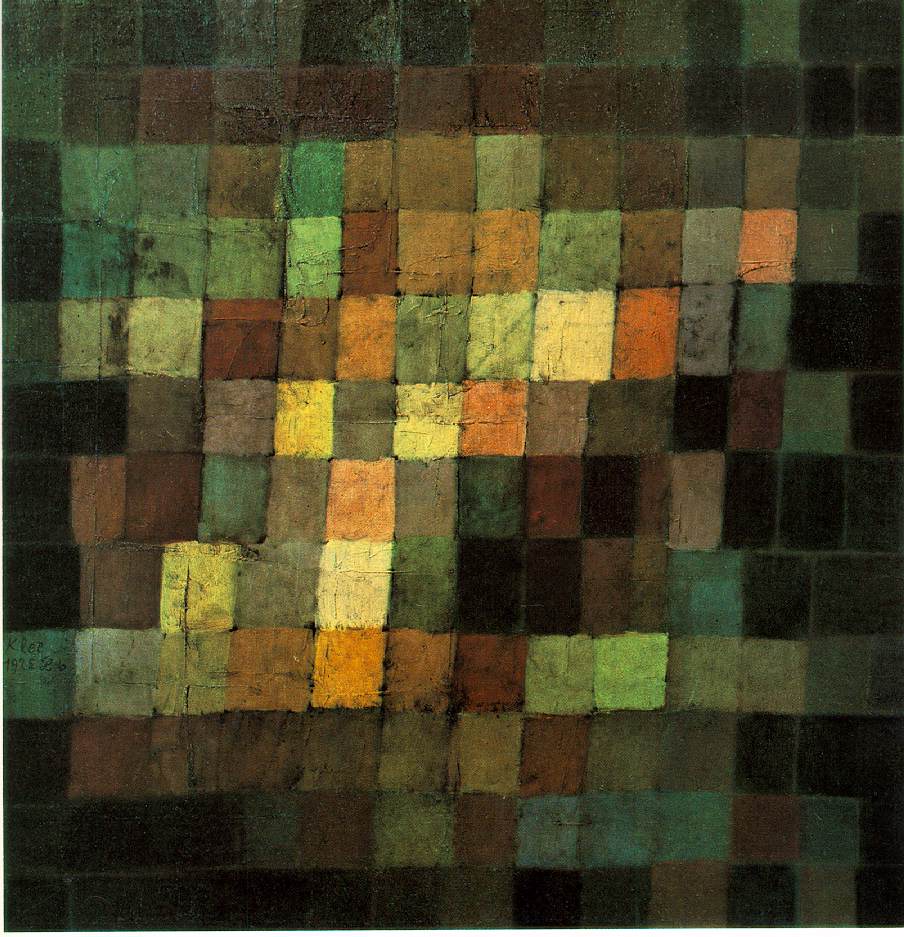
And here we take another swing through modern art. Some art seems to depict no objects at all - it is just about the forms, without subject. Most people call these works abstract and while that's not always technically correct*, I'll go ahead and use that term, as well.

How can abstract art communicate? How can it move us if it contains nothing we recognize.

Colors and composition (the arrangement/relationship of forms to each other and to their surroundings) can speak for themselves. This kind of art is for a narrower audience. Much of the audience is other artists, or people of visual arts sensibilities, who learn to enjoy the distilled form of the visual arts. (Image is of Paul Klee's painting Ancient Sound.

Actually, many people are quite used to abstract art in other forms. Music, without words, is an example of an abstract form. We can be deeply moved by music that has no subject or story. Samuel Barber's Adagio for Strings moves many people, and it's quite abstract. For some people the same is true of abstract painting and drawing. Certain arrangements of colors or shapes, light and dark, textures, volumes and spaces, can push our buttons like music does.

I've seen a lot of different reactions to abstract visual art. On the negative side there is a friend of mine who says, "it just doesn't do anything for me." He acknowledges that there is something going on - because others are tuned in and moved - but it doesn't reach him where he is. There is my reaction to a lot of sculpture, where I find I am not deaf, but pretty hard of hearing, so a lot of sculpture leaves me cold (though I love most Henry Moore, and I've learned to love Calder). There is the reaction of a relative who teases me about abstract art because she implies it isn't art at all, or a lesser form of art than objective or "beautiful" art. I maintain that beauty is a separate affair. I agree with her that the art we live with every day might be better chosen from the beautiful rather than the powerful, but abstract art can be both, if you're tuned to it.

I will never forget the day in my teens when we shopped for Christmas presents in Albany, NY. We were in the big mall on the government complex, and there was a huge underground passage that connected all the buildings. It seemed to be miles long. Since we were shopping for each other, we had split up, and I was hurrying down that long tunnel alone, dodging the crowds, and looking at the enormous abstract murals on the walls. Some were probably over a hundred feet long, and dozens of feet high, painted directly on the concrete. Most were just interesting to look at, but suddenly one made me stop and stand still. I was getting a message, a complicated, non-verbal message, and I liked it a lot. I walked slowly nearer to the piece and read its name. My mind seemed to explode with the possibilities, as the message and the title actually fit together and worked as a powerful whole. I "got" it for the first time - like a blind man suddenly seeing. I practically ran the whole rest of the long passage, looking at all the paintings carefully. Of the several dozen large paintings in that passage, several more suddenly opened up for me, now that the first one had paved the way.

And it happens to me still. I'll be walking down a street in Charleston, SC, looking in art gallery windows, and I'll suddenly be in danger for my life as the world disappears and I'm walking towards a painting, drinking it in, oblivious to traffic, pedestrians, the rain, whatever. The sensations are so much stronger, so uncluttered because there is no content other than composition. Pure form. It's as if abstract art were espresso and all other paintings were coffee. The abstract work is stronger, for me, and I am almost addicted to that hit.

But this is an acquired taste. And maybe, if I hadn't been arrogant about this taste when I was younger, and still hungrily protective of this aesthetic turf even now, that relative wouldn't tease me about it. That same relative doesn't like beer or most wines, but she understands that there is something there worthy of the connoisseur. She would probably have the same attitude towards abstract art (maybe she actually does) if I had handled it better when I was younger, and if I weren't so very serious about it still.

I need to lighten up.

*"Abstract art" is actually the end result of a process that started with a subject and removed the particular details, reducing the image to the essentials. What remains might only be the impression of the colors, or the shapes, or the visual movement and thrust of the objects, etc. Abstraction is an exploration, a mental exercise, and the end result may have no recognizable subject. On the other hand, there are artistic movements and techniques that create images without any starting subject. These may end up looking similar to abstractions, but they didn't go through the same process. So the correct technical name for both types together is "non-figurative" or "non-objective," meaning there are no recognizable objects in the end result. Of course these labels are hard to apply in many cases - like a piece that is meant to be read as non-objective (it's just about the composition) but viewers can still recognize objects.

Tuesday, January 1, 2008

What is Art - Part Four

Next I want to explore who is doing the art, when, and how across several different types of art.

For instance, when a ballet is performed, who is the artist? The choreographer? The composer? The dancers? The musicians?

I've discussed this with my dear wife (a skilled classical musician), and I've irritated her with the way I break this down. I hope I do it better this time. I believe this is an important additional way to understand art, and I have some new application of it to other art forms.

I would maintain that the performing arts have at least two layers of "art" going on whenever a piece is performed. There are the artists who initially created the piece (composer, choreographer, playwright, movie director, etc.) and the artists who make the piece present for an audience by performing it (musicians, dancers, actors, etc.). The lines get blurred when the composer performs, or when the director changes the piece for every performance, or when performers improvise, but that's not what I find interesting in this structure. What's interesting to me is this two tiered art status and what it might mean if we apply my definition of art to it.

First, the initial work (musical composition, ballet, play, movie) can be art or not just as I described in the last post. Did the creator intend to move us, communicating more deeply than the simple content of the piece?

But what's new is the addition of the second layer of artists - the performers. Should their act/art be determined the same way? I think so. I would maintain, in addition, that they can create art on two levels when performing. First, they can perform well enough (with enough sensitivity to the work) to transmit the original artist's intentions and move us. This is powerful enough, but some performers go beyond this; by interpretation of the original piece they add more message, more meaning, and move us more or differently. In this scheme Shakespeare can move us, then the director of a current production can move us more, and the actors can move us still more... This partially explains the overwhelming power of the performing arts. Not only do they grip an audience for prolonged periods because they unfold in time (time is one of the elements, the materials of the performing arts) but they can hold us spellbound because of this artistic layering. I have attended performances where so much was happening at different levels artistically that I could hardly breathe due to the pleasure and awe I felt.

Now let's take this pattern and stretch it over the so called "plastic" arts - the arts that create physical objects. The artist who creates a sculpture is like the composer or playwright, creating a unique, original work.

Is there an analogous structure to the performance? I think there is. I believe the sculptor (or painter, etc.) is creating art when communicate something new, move us in a new way. Then they often explore the new idea with a series of works in the same style or vein. These additional works, I contend, are like the performance. For the first piece the artist acted as the composer, for subsequent pieces in the series the artist is acting as the performer. And the show should probably run for just so many performances and then close. What I'm saying is that a breakthrough piece is more important (artistically) than the rest in the series. And the rest are craft - unless the artist manages to give additional life and value to each new interpretation of the original breakthrough piece, much the way a performing artist can. It could be that a later example in the series portrays the intentions and message of the artist even better than the earliest work. It's this striving, this continued search, that makes the subsequent pieces still art. Without that, they are craft - still fine, beautiful, valuable, etc., but I don't believe art is taking place.

I think some artists would argue with this - but I have known some of those same artists to insist that a colleague was a "hack" because they just mindlessly churned out the same things over and over again for money... There is an important distinction here, and I think artists know full well what it is. As long as the hunt is real and fresh, art is happening. As soon as it fades, every additional piece lacks the life and vigor of art - it's become craft. And let's face it, the hunt can be exhausting and artists have to earn a living - so the craft of producing additional versions of the same message makes sense.

Reflecting this back on the performing arts, we can understand how a great work can be performed by craftsmen. I have heard some performers called "technicians." It's still Bach's Preludio in E, a moving work of art, but it can be performed so it loses the life and message. Bach's art hasn't failed, but the performer is either not attempting art (the yare doing something else), or is failing at the attempt. By the way, I've heard performances that struck me as one or the other, and I'd almost always rather listen to a failed attempt than a technically perfect, but lifeless, rendering.

In the next post I want to discuss the content of visual artworks. There are interesting points to make (given my definition of art) about portraits, abstract art, and more.